1. When to come: the 82nd anniversary and other windows
The most meaningful time to visit is around June 6, the anniversary of D-Day. In 2026, this marks the 82nd anniversary and the D-Day Festival runs from May 30 to June 14. Commemorations, military re-enactments, fly-overs, and an evening concert and fireworks at Arromanches on June 6 itself.
But the beaches and museums are open year-round, and many veterans' families prefer a quieter visit:
- Late April – May: mild weather, fewer crowds, all sites open.
- Late June – August: warm, busy, but the seaside resort atmosphere of Arromanches comes alive.
- September – early October: our favourite. Light is exceptional, prices drop, museums are uncrowded.
- November (Veterans Day / Armistice): emotional, foggy, deeply atmospheric. Some cemeteries hold remembrance services.
Avoid the second week of August (French national holiday) if you want quiet — France is on the road then.
2. Getting to Normandy from abroad
From the United States and Canada
The fastest path is to fly to Paris Charles de Gaulle (CDG), then drive 3 hours west to Arromanches. There is no direct US flight to a Normandy airport.
- From the East Coast (NYC, Boston, DC): 7–8 hours overnight to CDG, daily nonstop flights on Delta, Air France, United, American.
- From the West Coast (LA, SF, Seattle): 10–11 hours nonstop to CDG on Air France, Delta, United.
- From Canada (Toronto, Montreal): 7 hours to CDG on Air Canada, Air France.
From CDG to Arromanches: rent a car (best option, ~3h drive via A13 + A84). Or train from CDG to Paris Saint-Lazare → Bayeux (about 3h total with transfer), then taxi to Arromanches (15 min, ~€25).
From the United Kingdom
Three options, ranked by what most of our British guests choose:
- Ferry Portsmouth → Caen (Ouistreham), Brittany Ferries. 6–7 hours, departures morning and overnight, vehicle included. This is the iconic D-Day route — you arrive at Sword Beach, just like the Allies. From Caen ferry terminal: 30 min drive to Arromanches.
- Eurotunnel (Folkestone → Calais), 35 min crossing, then 3h drive to Arromanches. Useful if you live north of London.
- Flight from London to Paris CDG or Beauvais, then car rental. Faster on paper but with bag drop, security and rental queue, not always a time saving.
From Australia, New Zealand, Asia-Pacific
Long-haul to London Heathrow, Frankfurt, or Paris CDG, then onward as above. Most Australian visitors we host combine the D-Day trip with London or Paris on the same itinerary — count at least 8–10 days door to door for the full circuit.
3. Where to stay: why we recommend Arromanches
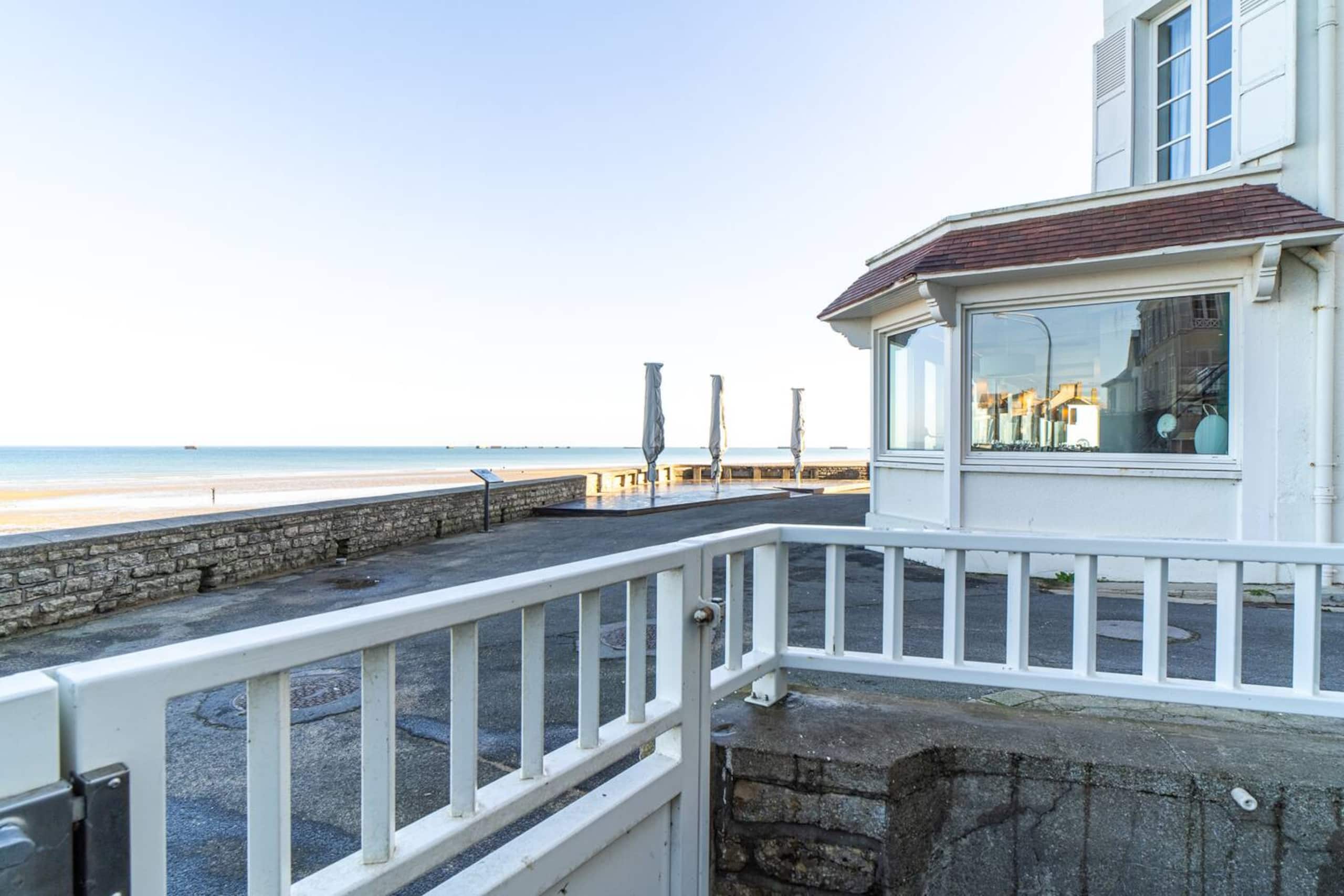
Most international D-Day visitors stay in Bayeux (10 km from Arromanches, hotels and B&Bs), but those who want the experience to be more immersive choose to stay on the beach itself. Arromanches is the only village right at the heart of the British Gold Beach landing zone, with the Mulberry artificial harbour at its doorstep.
What this means in practice:
- You walk to the D-Day Museum and 360° Cinema in 2 minutes.
- You sleep with the Mulberry caissons visible from your window.
- You can drive to Omaha Beach and Pointe du Hoc in 20 minutes, to Juno Beach in 15 minutes, to Bayeux in 10.
- You experience the British / Canadian sector by day and the American sector by morning trip.
For a group of 4 to 10, renting an entire house makes more sense than booking multiple hotel rooms. Villa Bellevue accommodates up to 10 guests across five bedrooms in the very centre of Arromanches — see also our guide on renting for ten in Normandy.
4. What to book before you arrive
Reserve these months ahead
1. Your villa or hotel (Arromanches and Bayeux fill up first, particularly for June 5–7).
2. D-Day Museum and Caen Memorial tickets (timed entries online).
3. A private guided tour or driver if you don't rent a car.
4. Ferry Portsmouth–Caen if coming from UK (book at least 3 months ahead for June).
5. Driving in Normandy: what to know
- Drive on the right. If you're from the UK or Australia, it takes 20 minutes to adjust.
- Most cars are manual transmission in Europe. Request automatic well ahead and expect to pay 30–40% more.
- Toll roads (autoroutes) charge by distance. CDG to Caen via A13 is approximately €30 one way. Cash and credit cards accepted.
- Speed limits: 130 km/h (80 mph) on autoroutes, 80 km/h (50 mph) on country roads, 50 km/h (30 mph) in villages. Strict enforcement by cameras.
- Parking in Arromanches is free in the village. The seawall in front of the villa is access-only for loading/unloading.
6. Visiting without a car: the NoMad Car summer coach
You don't strictly need a rental car to see the D-Day beaches in summer. From July 5 to August 31, 2026, 7 days a week, the Normandy Region operates the NoMad Car summer line 125, a coach service that runs the entire D-Day coastline between Courseulles-sur-Mer (Juno Beach) and Grandcamp-Maisy (west of Omaha), stopping in Arromanches, Port-en-Bessin, Vierville-sur-Mer, Colleville-sur-Mer (American Cemetery) and more.
To get to the coast from Bayeux (where the SNCF train from Paris arrives), use the connecting lines: line 121 Bayeux ↔ Arromanches and line 120 Bayeux ↔ Port-en-Bessin, both year-round.
This makes a train + coach itinerary realistic: Paris Saint-Lazare → Bayeux (about 2h15 by SNCF), then line 121 to Arromanches, then line 125 to explore the beaches over a few days. Fares are very low compared to a rental + tolls + parking. All info, timetables and ticketing: nomad.normandie.fr.
7. A suggested 5-day D-Day itinerary
Day 1 — Arrival and acclimatisation
Land at CDG morning, drive to Arromanches (3h), check in late afternoon. Walk the seawall at golden hour, dinner at Le Mouton Rathouin or La Petite Plage.
Day 2 — The British and Canadian sector
Morning: D-Day Museum and Mulberry remains on foot (100 m from the villa). Afternoon: Juno Beach Centre at Courseulles (15 min drive) and Pegasus Bridge (45 min). Sunset back at Arromanches 360 cinema platform.
Day 3 — The American sector
Full day. Drive 20 min to Colleville-sur-Mer for the Normandy American Cemetery, then Omaha Beach, then Pointe du Hoc. Lunch in Vierville or Port-en-Bessin. Return for dinner at the villa.
Day 4 — Caen Memorial and Bayeux
Morning at the Caen Memorial (35 min drive, plan 3h+ inside). Afternoon in Bayeux for the Bayeux Tapestry and the British Cemetery (4,144 Commonwealth graves). Read also our guide to visiting Bayeux.
Day 5 — Slow morning, departure
Coffee at the bow window, walk on the beach at low tide, drive back to CDG (3h). Allow a buffer if your flight is in the afternoon.
If you have more time, extend with Mont-Saint-Michel (1h45 west) or Honfleur (1h east).
8. Useful local etiquette
The American Cemetery and respectful behaviour
The cemetery is on land granted to the United States in perpetuity. Dress respectfully (no swimwear, no shorts above the knee). The 4pm flag-lowering ceremony is moving and free to attend.
French time and meal hours
Lunch is 12:00–14:00 sharp. Dinner is 19:30 onwards. Many restaurants close in the afternoon. Plan accordingly or you'll be eating supermarket sandwiches.
French greetings
Start every shop or restaurant interaction with "Bonjour" — even a hesitant one. It opens every door. Locals appreciate the effort.
9. With a veteran or with descendants
We have hosted several families travelling with WWII veterans (in their late 90s and 100s, often on what they know will be a final visit). A few specific tips:
- The villa has no elevator: bedrooms are upstairs. Ask us about ground-floor sleeping arrangements (we can rearrange the salon).
- Mobility at the beach: the seawall is paved and accessible. The cemetery and museums are all wheelchair-accessible.
- Veteran organisations: contact the American Battle Monuments Commission (abmc.gov) for free guided cemetery visits. The Normandy American Visitor Center offers veteran families specific arrangements.
- Honour visits: the French Ministry of Veterans Affairs can organise an official welcome ceremony for visiting veterans during the anniversary period — contact your nearest French consulate 3 months ahead.
10. Money, language, paperwork
- Currency: euros (€). 1 USD ≈ €0.92, 1 GBP ≈ €1.17 (varies). Credit cards accepted almost everywhere. ATMs in Arromanches and Bayeux.
- Tipping: not required (service is included). Round up or leave a few euros if service was good.
- Language: French. Restaurant menus often have English translations. Most museum staff speak English. Our hosts at Villa Bellevue speak both.
- Passport / visa: US, UK, Canadian and Australian citizens do not need a visa for stays under 90 days. ETIAS (the new EU electronic authorisation) is planned but the official start has been postponed several times — check europa.eu before you travel.
- Health insurance: pack travel insurance. European Health cards (UK) accepted for emergencies; US visitors should rely on travel insurance.
- SIM / data: most US/UK/Canadian carriers offer EU roaming. Or buy a local SIM from Orange/SFR/Free in any tabac shop.
10. Photography and souvenirs
Photography is welcome at all D-Day sites including the American Cemetery (no flash inside the chapel). For souvenirs, avoid the tourist shops near the bus park — better quality and prices at the museum gift shops. The most touching souvenirs are usually the things you find at home: sand from Omaha or Gold Beach, a Bessin cheese to share back home, a Bayeux Tapestry print.
11. A final word
Whatever brings you here — family history, scholarship, curiosity, or pilgrimage — you are joining a quiet stream of people who have made this trip since 1945. The locals see you as part of the village's purpose. Many of our older neighbours remember the days, others have inherited the stories. Take the time to talk, to listen, and to walk slowly. The beaches did not give up their dead easily; they don't give up their meaning quickly either.
If you want a place where you can spread out, host your family for a few days, and step out the door right onto the Mulberry harbour — we'd be honoured to host you.
Related reading
- The D-Day beaches on foot, by car or by bike — three itineraries
- Events in Arromanches 2026 — Monthly agenda and tips
- What to do in Arromanches: a complete guide by a local
- Visiting Bayeux from Arromanches
- Renting for ten in Normandy: everything you need to know
The villa awaits you
1857 seaside house, 10 guests, 100 m from the D-Day Museum.
Check availability →