The two beaches on June 6, 1944
Utah Beach — the westernmost landing beach, on the eastern coast of the Cotentin peninsula. Assigned to the US 4th Infantry Division. Landing craft drifted about 2 km south of the planned point, which turned out to be a lightly defended sector. Casualties by end of day: around 200 US soldiers. Considered the "easy" landing — relatively.
Omaha Beach — 25 km east of Utah, between Colleville-sur-Mer and Vierville-sur-Mer. Assigned to the US 1st and 29th Infantry Divisions. Steep bluffs, strong German defensive positions (in particular WN-62 and WN-72), rough seas that swamped landing craft. Casualties: around 2,400 US soldiers — the highest of any D-Day beach. Known ever since as "Bloody Omaha".
What you see today
Utah Beach
- Utah Beach Museum — one of the best D-Day museums, built directly on a German blockhouse. Includes a restored B-26 bomber. Allow 1h30. ~€10.
- The beach itself — wide, flat, sandy. Long dune walk. Peaceful and open.
- Higgins boat and Sherman tank monuments on the beach.
- Roosevelt monument — Brigadier General Theodore Roosevelt Jr. landed here at age 56, one of the highest-ranking officers to land with the first wave.
Omaha Beach
- The beach itself — walk the sand from Saint-Laurent to Vierville. You feel the width, the openness, the exposure.
- Normandy American Cemetery (Colleville-sur-Mer) — 9,388 graves, marble crosses and Stars of David, in perfect alignment above the beach. The emotional heart of an American D-Day trip. Free. Allow 2h including the visitor centre and the Wall of the Missing.
- Les Braves memorial — striking steel sculpture on the beach at Saint-Laurent.
- Overlord Museum — private museum near the cemetery, ~€10.
- WN-62 remains — German bunker complex, walkable.
Between the two beaches: Pointe du Hoc — the cliff assault by Colonel James Rudder's 2nd Ranger Battalion. Craters still visible 82 years later. Free, atmospheric, allow 1h.
Distance and driving
Utah and Omaha are 45 km apart by road, about 55 minutes drive via the D514. From Arromanches (base): Omaha is 30 min, Utah is 55 min. Pointe du Hoc sits roughly halfway between the two beaches.
Suggested one-day loop from Arromanches (west to east): Arromanches → Utah Beach (55 min) → Sainte-Mère-Église (20 min) → Pointe du Hoc (30 min) → Omaha Beach (20 min) → Normandy American Cemetery (5 min) → Arromanches (30 min). Long but doable.
For families with kids
Utah Beach Museum is arguably more child-friendly: the restored B-26 bomber, the tanks, the interactive Higgins boat displays. Younger kids engage with the physical objects.
The Normandy American Cemetery is age-appropriate for older children (~10+) and can be genuinely moving for teenagers. Explain the context beforehand.
Pointe du Hoc — kids love the craters and bunkers, but watch cliff edges.
The emotional temperature
Utah Beach is instructive; Omaha Beach is moving. If you have a family connection to a US veteran, or a strong emotional expectation of your visit, Omaha and the American Cemetery deliver it. Utah is the strategic context — where the success of the day was measurable in the low casualty count — and it deepens the understanding of what Omaha cost.
Both deserve their place in a serious D-Day trip.
Where to stay
The American sector has few large-capacity vacation rentals. Most visitors stay in Arromanches or Bayeux (30 min east) and day-trip. Bayeux vs Arromanches — where to stay.
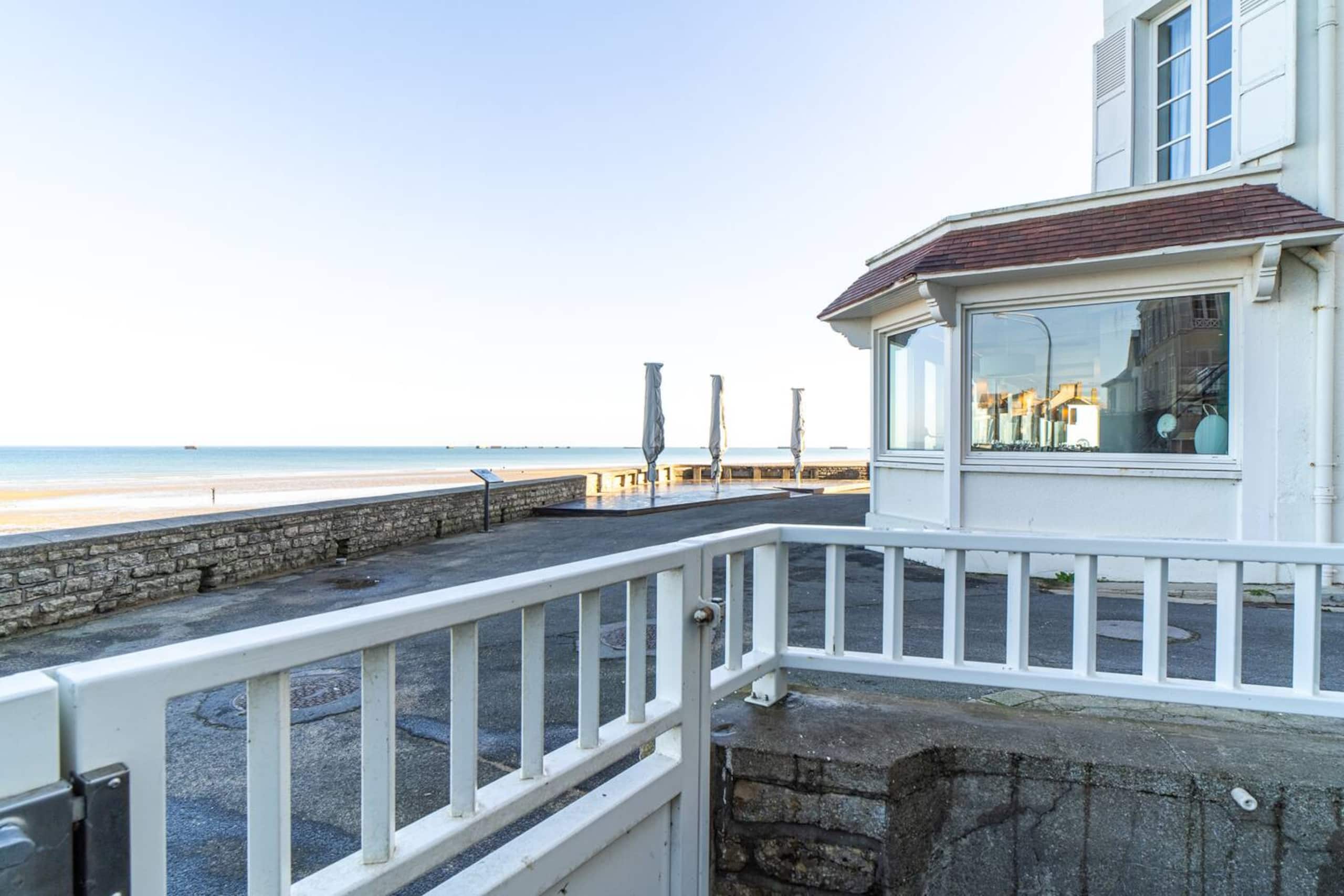
Villa Bellevue in Arromanches sleeps 10, sea view, 100 m from the D-Day Museum. Practical base for both the American and British-Canadian sectors.
Quick Q&A — Utah vs Omaha
What's the difference?
Utah was a relatively successful landing (~200 US casualties). Omaha was the bloodiest of D-Day (~2,400 US casualties) due to bluffs, defences and rough seas.
Which is more important?
If you can only visit one, Omaha — the Normandy American Cemetery (9,388 graves) sits above it.
How far apart?
45 km, 55 min by road. Pointe du Hoc sits roughly halfway between them.
One day for both?
Yes, doable but heavy: Utah + Sainte-Mère-Église + Pointe du Hoc + Omaha + American Cemetery. Two days is more comfortable.
Free to visit?
Both beaches: free. Normandy American Cemetery: free. Museums (Utah Beach ~€10, Overlord ~€10): paid.
June 6 ceremonies?
Yes — official ceremonies every year at Utah Beach and at the American Cemetery. Passes sometimes required. Book 6-12 months ahead.
Stay at Villa Bellevue — a practical base for both sectors
10 guests, sea view, 100 m from the D-Day Museum. 30 min from Omaha, 55 min from Utah, 30 min from Juno.
Check availability →Prefer a private guided tour?
Our local partner Mathilde Legoupil — bilingual licensed tour guide (Immersive Normandy Tours) — runs private half-day and full-day tours of the D-Day beaches, Bayeux, the Longues-sur-Mer battery, Mont-Saint-Michel and Giverny. Ideal for American, British, Canadian and Australian visitors who want context and depth without driving themselves. See her profile on our partners page.